 c39168453d
* feat(i18n): localize /model command output

Reported by @tianma8888: when Chinese users run /model, the labels
("Provider:", "Context:", "_session only_", etc.) are still English.
This routes the static prose through the existing i18n catalog so it
follows display.language / HERMES_LANGUAGE.

Changes:
- locales/{en,zh,ja,de,es,fr,tr,uk}.yaml: add 17 keys under
  gateway.model.* covering switched/provider/context/max_output/cost/
  capabilities/prompt_caching/warning/saved_global/session_only_hint/
  current_label/current_tag/more_models_suffix/usage_*.
- gateway/run.py _handle_model_command: replace hardcoded f-strings in
  the picker callback, the text-list fallback, and the direct-switch
  confirmation block with t("gateway.model.<key>", ...).

What stays English:
- model IDs, provider slugs, capability strings, cost figures, and the
  "[Note: model was just switched...]" prepended to the model's next
  prompt (LLM-facing, not user-facing).
- The two slightly-different session-only hints unify on a single key
  with the em-dash phrasing.

Validation: tests/agent/test_i18n.py 27/27 passing (parity contract
holds), tests/gateway/ -k 'model or i18n' 74/74 passing.

* feat(i18n): localize all gateway slash command outputs

Expands the i18n catalog from 7 strings to 234 keys across 35 gateway
slash command handlers, so non-English users see localized output for
\`/profile\`, \`/status\`, \`/help\`, \`/personality\`, \`/voice\`, \`/reset\`,
\`/agents\`, \`/restart\`, \`/commands\`, \`/goal\`, \`/retry\`, \`/undo\`,
\`/sethome\`, \`/title\`, \`/yolo\`, \`/background\`, \`/approve\`, \`/deny\`,
\`/insights\`, \`/debug\`, \`/rollback\`, \`/reasoning\`, \`/fast\`,
\`/verbose\`, \`/footer\`, \`/compress\`, \`/topic\`, \`/kanban\`,
\`/resume\`, \`/branch\`, \`/usage\`, \`/reload-mcp\`, \`/reload-skills\`,
\`/update\`, \`/stop\` (plus the \`/model\` block already added in the
previous commit).

Reported by @tianma8888 — Chinese users want command output prose in
their language, not just the labels we already had.

Translations are hand-written for all 8 supported locales (en, zh, ja,
de, es, fr, tr, uk), matching each catalog's existing style: full-width
punctuation in zh, em-dashes in zh/ja/uk, French spaced colons,
German noun capitalization, etc.

What stays English (unchanged):
- Identifiers/values: model IDs, file paths, profile names, session IDs,
  command flag names like --global, URLs, config keys.
- Backtick code spans: \`/foo\`, \`config.yaml\`.
- Log messages (logger.info/warning/error).
- LLM-facing system notes prepended to next prompt (e.g. [Note: model
  was just switched...]).
- Strings produced by external modules (gateway_help_lines,
  format_gateway, manual_compression_feedback) — those have their
  own surfaces.

New shared keys for cross-handler boilerplate:
- gateway.shared.session_db_unavailable (5 call sites: branch, title,
  resume, topic, _disable_telegram_topic_mode_for_chat)
- gateway.shared.session_not_found (1 site)
- gateway.shared.warn_passthrough (2 sites in /title's f"⚠️ {e}" pattern)

YAML gotcha fixed: \`yolo.on\` and \`yolo.off\` were originally written
unquoted, which YAML 1.1 parses as boolean True/False keys. Renamed to
\`yolo.enabled\` / \`yolo.disabled\` for both safety and clarity.

Test fix: tests/agent/test_i18n.py::test_t_missing_key_in_non_english_falls_back_to_english
now resets the catalog cache on teardown, so the fake "foo: English Foo"
locale doesn't poison the module-level cache for subsequent tests in
the same xdist worker. (Without this, every gateway slash command test
that shares a worker with the i18n suite would see the fake catalog.)

Validation:
- tests/agent/test_i18n.py: 27/27 (parity contract — every key in every
  locale, matching placeholder tokens).
- tests/gateway/: 5077 passed, 0 failed (full gateway suite).
- 180 t() call sites added across 35 handlers; 1872 catalog entries
  total (234 keys × 8 locales).

* feat(i18n): add 8 new locales — af, ko, it, ga, zh-hant, pt, ru, hu

Expands the static-message catalog from 8 → 16 languages, each with full
270-key parity against the English source-of-truth.  Every locale now
covers the same surface PR #22914 added: approval prompts plus all 35
gateway slash command outputs.

New locales:
- af  Afrikaans      (community ask in #21961 by @GodsBoy; PRs #21962, #21970)
- ko  Korean         (PRs #20297 by @tmdgusya, #22285 by @project820)
- it  Italian        (PR #20371 by @leprincep35700)
- ga  Irish/Gaeilge  (PR #20962 by @ryanmcc09-dot)
- zh-hant Traditional Chinese (PRs #20523 by @jackey8616, #13140 by @anomixer)
- pt  Portuguese     (PRs #20443 by @pedroborges, #15737 by @carloshenriquecarniatto, #22063 by @Magaav)
- ru  Russian        (PR #22770 by @DrMaks22)
- hu  Hungarian      (PR #22336 by @lunasec007)

Each locale uses native-quality translations matching the existing tone
and conventions of the older 8 locales:
- zh-hant uses 繁體 characters with TW/HK technical vocabulary (軟體
  not 软件, 連線 not 连接, 設定 not 设置, 訊息 not 消息, 工作階段 not 会话, 程式
  not 程序, 預設 not 默认, 伺服器 not 服务器), full-width punctuation 「:()」.
- ko uses formal 합니다체 (습니다/합니다) register throughout.
- pt uses European Portuguese as baseline with neutral PT/BR vocabulary
  where possible.
- ga uses standard An Caighdeán Oifigiúil; English loanwords retained
  for tech terms without good Irish equivalents (gateway, API, JSON).
- All preserve {placeholder} tokens, backtick code spans, slash commands,
  brand names (Hermes, MCP, TTS, YOLO, OpenAI, Telegram, etc.), and emoji.

Aliases added in agent/i18n.py:
- af-za, Afrikaans → af
- ko-kr, Korean, 한국어 → ko
- it-it, italiano → it
- ga-ie, Irish, Gaeilge → ga
- zh-tw, zh-hk, zh-mo, traditional-chinese → zh-hant (note: zh-tw used to
  alias to zh; now aliases to its own zh-hant catalog)
- zh-cn, zh-hans, zh-sg → zh (unchanged from before)
- pt-pt, pt-br, brazilian, portuguese → pt
- ru-ru, Russian, русский → ru
- hu-hu, Magyar → hu

The zh-tw alias re-routing is intentional: previously typing 'zh-TW' got
the Simplified Chinese catalog (wrong vocabulary for Taiwan/HK users).
Now those users get the proper Traditional Chinese catalog.

Validation:
- tests/agent/test_i18n.py: 43/43 (parity contract holds for all 16
  languages × 270 keys = 4320 catalog entries, with matching placeholder
  tokens).
- E2E alias resolution verified for all 19 alias inputs (Afrikaans, ko-KR,
  한국어, italiano, Gaeilge, zh-TW, zh-HK, traditional-chinese, pt-BR,
  brazilian, Magyar, etc.).
- tests/gateway/: 5198 passed (3 pre-existing TTS routing failures
  unrelated to i18n).

Credit to all contributors whose PRs surfaced these language requests.
Their original PRs may now be closed as superseded with credit.

* feat(dashboard-i18n): add 14 web dashboard locales matching the static catalog

Brings the React dashboard (web/src/) up to the same 16-language
coverage the static catalog already has after the previous commits in
this PR. The Translations interface is TypeScript-typed, so every new
locale must provide every key — tsc -b is the parity guard.

Languages added (each is a complete 429-line locale file):
- af  Afrikaans
- ja  Japanese        (PR #22513 by @snuffxxx surfaced this)
- de  German          (PR #21749 by @mag1art)
- es  Spanish         (PR #21749)
- fr  French          (PRs #21749, #10310 by @foXaCe)
- tr  Turkish
- uk  Ukrainian
- ko  Korean          (PRs #21749, #18894 by @ovstng, #22285 by @project820)
- it  Italian
- ga  Irish (Gaeilge)
- zh-hant Traditional Chinese (PR #13140 by @anomixer)
- pt  Portuguese      (PRs #22063 by @Magaav, #22182 by @wesleysimplicio, #15737 by @carloshenriquecarniatto)
- ru  Russian         (PRs #21749, #22770 by @DrMaks22)
- hu  Hungarian       (PR #22336 by @lunasec007)

Each translation covers all 15 namespaces with full key parity vs en.ts,
preserves every {placeholder} token verbatim, keeps identifiers
untranslated (brand names, file paths, cron expressions, code spans),
translates the language.switchTo tooltip into the target language, and
matches existing tone conventions (zh-hant uses TW/HK vocab; ja uses
formal desu/masu; ko uses formal seumnida register; ga uses An
Caighdean Oifigiuil with English loanwords for tech vocab without good
Irish equivalents).

Plumbing:
- web/src/i18n/types.ts: Locale union expanded to all 16 codes.
- web/src/i18n/context.tsx: imports all 16 catalogs; exports
  LOCALE_META (endonym + flag per locale); isLocale() type guard.
- web/src/i18n/index.ts: re-export LOCALE_META.
- web/src/components/LanguageSwitcher.tsx: replaced two-state EN-ZH
  toggle with a click-to-open dropdown listing all 16 languages.

Note: zh-hant.ts exports zhHant (camelCase) since hyphen is invalid in
a JS identifier; the canonical 'zh-hant' string keys it in TRANSLATIONS.

Validation:
- npx tsc -b: 0 errors. Every locale satisfies Translations.
- npm run build (tsc + vite production): green, 2062 modules.
- Each locale file is exactly 429 lines.

Out of scope: plugin dashboards (kanban/achievements ship as prebuilt
bundles with no source in repo); Docusaurus docs (separate surface);
TUI (no i18n yet).

* feat(plugin-i18n): localize achievements + kanban plugin dashboards across all 16 locales

Brings the two shipped plugin dashboards (hermes-achievements, kanban)
under the same i18n umbrella as the core dashboard PR #22914 just
established.  Both bundles now read user-facing strings from the host's
i18n catalog via SDK.useI18n() instead of hardcoded English.

## Approach

Plugin dashboards ship as prebuilt IIFE bundles in
plugins/<name>/dashboard/dist/index.js — no build step, no source in
repo (upstream-authored, vendored as compiled JS).  Earlier contributor
PRs (#22594, #22595, #18747) tried direct edits but didn't actually
wire the bundles to read translations.

This change does the wiring properly:

1.  Each bundle gets a useI18n shim at IIFE scope:
        const useI18n = SDK.useI18n
          || function () { return { t: { kanban: null }, locale: "en" }; };
    Older host SDKs without useI18n still load the bundle and render
    English fallbacks.

2.  A small tx(t, path, fallback, vars) helper resolves dotted keys
    under the plugin's namespace (t.kanban.* or t.achievements.*) and
    interpolates {placeholder} tokens.

3.  Every React component starts with const { t } = useI18n() and
    each user-visible string is wrapped in tx(t, "key", "English fallback").
    Helpers called outside React components (window.prompt callers,
    constants used during init) take t as a parameter.

4.  Top-level constants that were English dictionaries (COLUMN_LABEL,
    COLUMN_HELP, DESTRUCTIVE_TRANSITIONS, DIAGNOSTIC_EVENT_LABELS in
    kanban) become getColumnLabel(t, status)-style functions backed by
    FALLBACK_* dictionaries.

## Translations added

Two new top-level namespaces added to the dashboard's TypeScript-typed
Translations interface:

- achievements: ~70 keys covering the hero, scan banner, achievement
  card, share dialog, stats, filters, and empty states.
- kanban: ~145 keys covering the board, columns (with nested
  columnLabels and columnHelp sub-dicts), card detail panel,
  bulk-actions toolbar, dependency editor, board switcher, and
  diagnostic callouts.

Each key is provided across all 16 supported locales:
en, zh, zh-hant, ja, de, es, fr, tr, uk, af, ko, it, ga, pt, ru, hu.

Total new translation entries: ~3,440 (215 keys × 16 locales).

## What stays English (deliberate)

- API paths, CSS class names, data-* attributes, JSON keys, regex
  strings, URLs, file paths (~/.hermes/kanban.db, boards/_archived/).
- State identifier strings used as lookup keys (triage / todo / ready /
  running / blocked / done / archived) — labels translate, key strings
  don't.
- The PNG share-card text rendered to canvas in the achievements
  ShareDialog (HERMES AGENT watermark, UNLOCKED stamp, tier names) —
  these become part of a globally-shared image and stay English.
- localStorage keys (hermes.kanban.selectedBoard).
- Brand names (Kanban, Hermes, WebSocket, Nous Research).

## Contributor credit

PR #22594 by @02356abc and PR #22595 by @02356abc supplied the
en + zh kanban namespace skeleton (145 keys); used as the en source-
of-truth in this commit and translated to the other 14 locales.

PR #18747 by @laolaoshiren first surfaced the achievements
localization request.

## Validation

- npx tsc -b: 0 errors. All 16 locale .ts files satisfy the
  Translations type with full key parity.
- npm run build (tsc + vite production build): green, 2062 modules,
  1.56MB JS / 95KB CSS, ~2.5s build.
- node --check on both plugin bundles: parse cleanly.
- 126 tx() call sites in kanban, 46 in achievements.

## Out of scope

- TUI (ui-tui/) has no i18n infrastructure yet.
- Docusaurus docs (website/i18n/) — already had zh-Hans; expanding
  is a separate translation workstream (Thai / Korean / Hindi PRs).
|
||
|---|---|---|
| .. | ||
| dashboard | ||
| docs | ||
| tests | ||
| LICENSE | ||
| README.md | ||
Hermes Achievements
Bundled with Hermes Agent. Originally authored by @PCinkusz at https://github.com/PCinkusz/hermes-achievements — vendored into
plugins/hermes-achievements/so it ships with the dashboard out-of-the-box and stays in lockstep with Hermes feature changes. Upstream repo remains the staging ground for new badges and UI iteration.When Hermes is installed via
pip install hermes-agentor cloned from source, this plugin auto-registers as a dashboard tab on firsthermes dashboardlaunch. No separate install step. See Built-in Plugins → hermes-achievements in the main docs.
Achievement system for the Hermes Dashboard: collectible, tiered badges generated from real local Hermes session history.
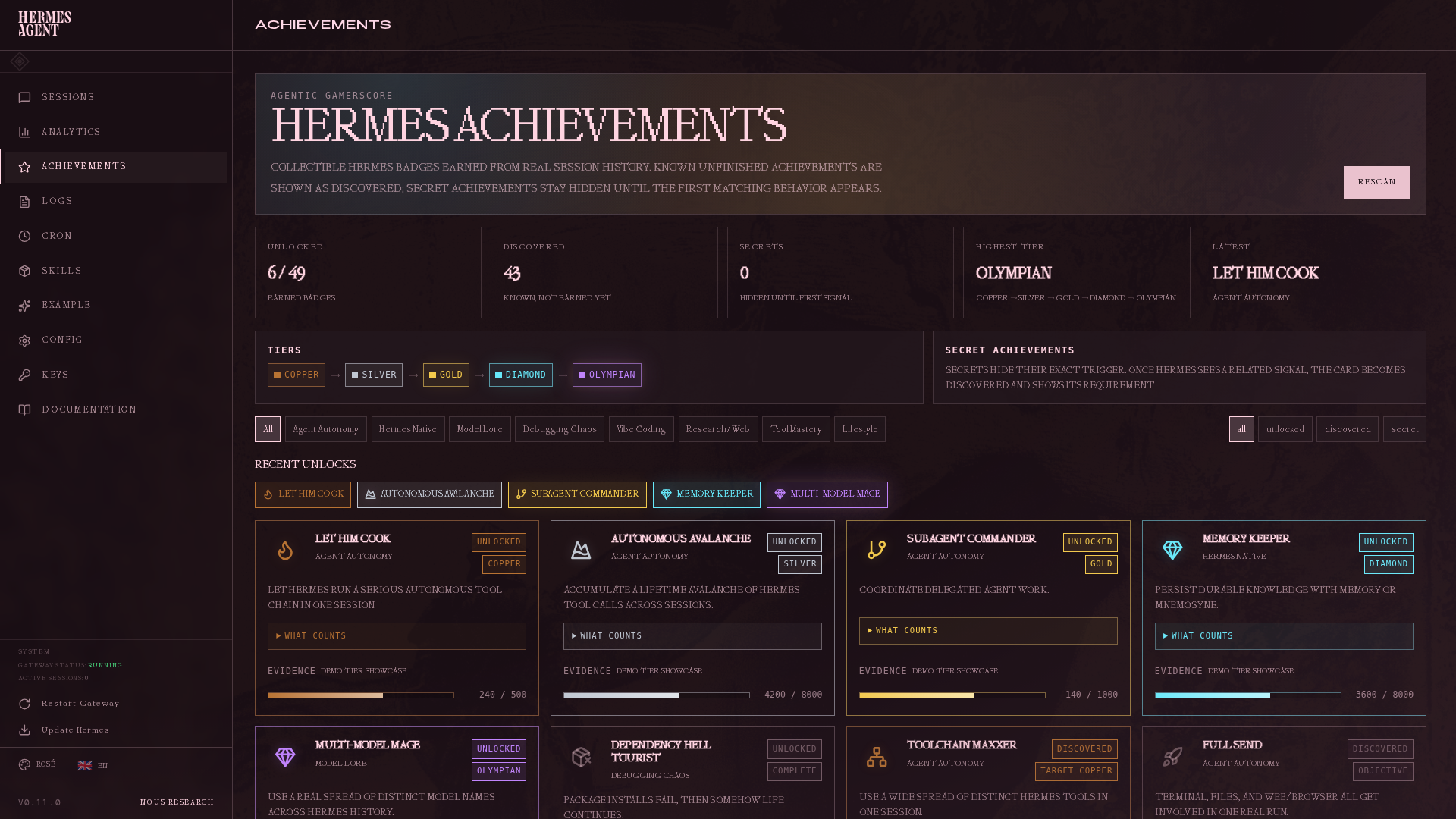
The screenshots use temporary demo tier data to show the full visual range. The plugin itself reads real local Hermes session history by default.
Update notice (2026-04-29): If you installed this plugin before today, update to the latest version. The achievements scan path was refactored for much faster warm loads (snapshot cache + incremental checkpoint scan).
Share cards (2026-05-04, vendored in hermes-agent v0.4.0): Unlocked achievement cards now have a "Share" button that renders a 1200×630 PNG share card (client-side canvas, no backend, no network) with Download + Copy-to-clipboard actions. Fits X/Twitter, Discord, LinkedIn, Bluesky link-preview dimensions.
What it does
Hermes Achievements scans local Hermes sessions and unlocks badges based on real agent behavior:
- autonomous tool chains
- debugging and recovery patterns
- vibe-coding file edits
- Hermes-native skills, memory, cron, and plugin usage
- web research and browser automation
- model/provider workflows
- lifestyle patterns such as weekend or night sessions
Achievements have three visible states:
- Unlocked — earned at least one tier
- Discovered — known achievement, progress visible, not earned yet
- Secret — hidden until Hermes detects the first related signal
Most achievements level through:
Copper → Silver → Gold → Diamond → Olympian
Each card has a collapsible What counts section showing the exact tracked metric or requirement once the user wants details.
Version 0.2.x expands the catalog to 60+ achievements, including model/provider badges such as Five-Model Flight, Provider Polyglot, Claude Confidant, Gemini Cartographer, and Open Weights Pilgrim.
Examples
- Let Him Cook
- Toolchain Maxxer
- Red Text Connoisseur
- Port 3000 Is Taken
- This Was Supposed To Be Quick
- One More Small Change
- Skillsmith
- Memory Keeper
- Context Dragon
- Plugin Goblin
- Rabbit Hole Certified
Install
Clone into your Hermes plugins directory:
git clone https://github.com/PCinkusz/hermes-achievements ~/.hermes/plugins/hermes-achievements
For local development, keep the repo elsewhere and symlink it:
git clone https://github.com/PCinkusz/hermes-achievements ~/hermes-achievements
ln -s ~/hermes-achievements ~/.hermes/plugins/hermes-achievements
Then rescan dashboard plugins:
curl http://127.0.0.1:9119/api/dashboard/plugins/rescan
If backend API routes 404, restart hermes dashboard; plugin APIs are mounted at dashboard startup.
Updating
If you installed with git:
cd ~/.hermes/plugins/hermes-achievements
git pull --ff-only
curl http://127.0.0.1:9119/api/dashboard/plugins/rescan
If the update changes backend routes or plugin_api.py, restart hermes dashboard after pulling.
As of 2026-04-29, updating is strongly recommended because scan performance changed significantly:
- removed duplicate
/overviewscan path - added cached
/achievementssnapshot - added incremental checkpoint reuse for unchanged sessions
Achievement unlock state is stored locally in state.json and is not overwritten by git updates. New achievements are evaluated from your existing Hermes session history. Achievement IDs are stable and should not be renamed casually because they are the unlock-state keys.
Releases are tagged in git, for example:
git fetch --tags
git checkout v0.2.0
Files
dashboard/
├── manifest.json
├── plugin_api.py
└── dist/
    ├── index.js
    └── style.css
API
Routes are mounted under:
/api/plugins/hermes-achievements/
Endpoints:
GET  /achievements
GET  /scan-status
GET  /recent-unlocks
GET  /sessions/{session_id}/badges
POST /rescan
POST /reset-state
Development
Run checks:
node --check dashboard/dist/index.js
python3 -m py_compile dashboard/plugin_api.py
python3 -m unittest tests/test_achievement_engine.py -v
License
MIT